
The vertical Mycenaean loom
The “web” of Penelope
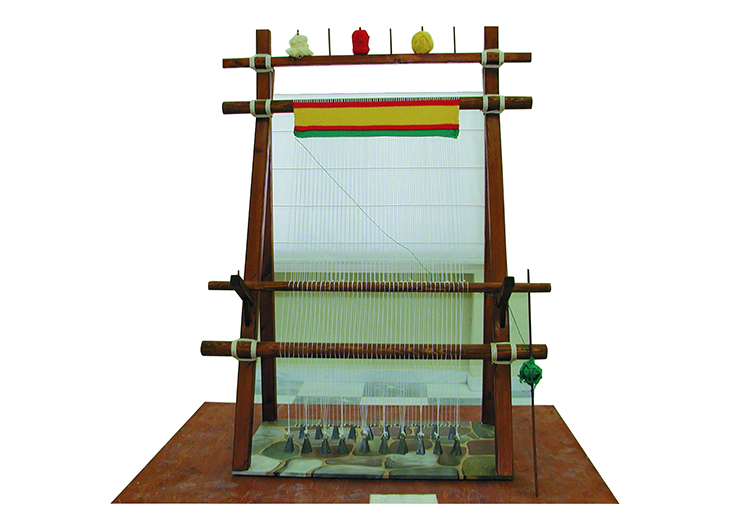
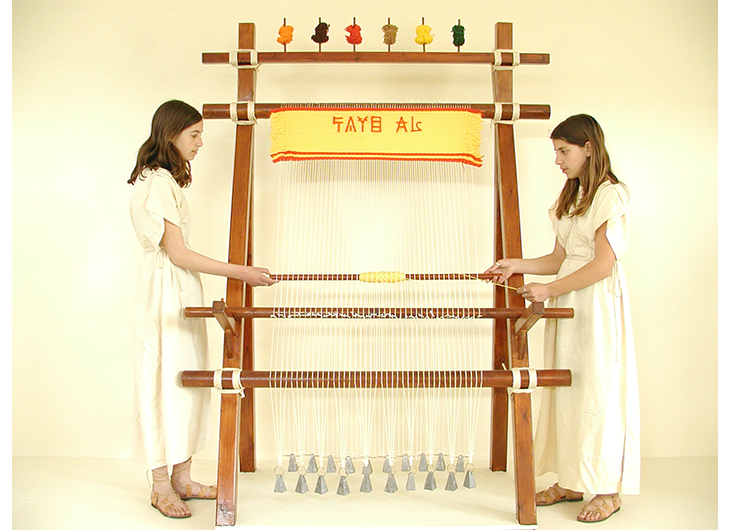
It consisted of 4 poles (istopodes or keleontes) on which a horizontal cylindrical beam (cloth-roller) was fastened. Another cloth-roller was fastened at the mid-bottom of the loom. In order to strain the warps, lead, stone or clay loom weights (plumbs) of pyramidal shape were tied at their bottom. The interchange of warps was facilitated by the heddles, that is, the loops on the small horizontal cylindrical piece of wood, which the weaver dragged back and forth in turn, so that the stick of yarn (shuttle) would pass through the warps. Weaving took place from bottom to top and the woven cloth was wrapped around the cloth-roller.
SOURCES: The construction was based on iconographical information from 23 different ancient vases [e.g. skyphos (cup) of Chiusi, 450-400 B.C., crater from Pisticci, ca 430 B.C., lekythos (oil flask), Metropolitan Museum of Art, New York, ca 550-530 B.C.], which complemented each other but sometimes also contradicted one another