Ancient Greek Technology: The Origins of Robotics and Engineering

Ancient Greek technology is not a distant or primitive past — it represents a lost peak of innovation.
A lost peak of innovation
At the height of the Hellenistic era, engineers and inventors developed mechanisms that closely resemble the foundations of modern technology. From automated systems and robotics to steam power and programmable machines, ancient Greek engineers explored ideas that would only re-emerge many centuries later.
What is perhaps most striking is not only the level of technological sophistication, but how familiar these inventions feel today.
The desire to automate tasks, to entertain, to measure time, and to interact with intelligent systems is not unique to our era. These same needs existed in ancient societies. What has changed is not the human ambition — but the tools used to express it.
Alexandria: a city of technological wonders
Walking through the ancient city of Alexandria, one would not encounter a primitive world, but a landscape filled with technological wonders.
Imagine a visitor gathering with a crowd to watch a mechanical performance unfold — a story brought to life through motion, sound, and light. These experiences were not abstract experiments, but part of everyday life.
The foundations of modern engineering: gears, valves and automation
Ancient Greek engineers developed technologies that form the foundations of modern systems: gears and mechanical transmissions, valves and hydraulic control systems, automation and early programming concepts. These were not isolated inventions, but parts of a broader technological ecosystem.
Ancient Greek technology brought back to life
At the Kotsanas Museum of Ancient Greek Technology, these mechanisms are brought back to life through fully functional reconstructions, allowing visitors to experience directly the logic and ingenuity behind them.
The Automatic Servant of Philon: the first robot
One of the most striking examples is the automatic servant of Philon — a life-sized humanoid mechanism capable of serving wine and water. When a visitor placed a cup in its hand, the system responded automatically, pouring liquid in controlled proportions. This mechanism relied on air pressure, valves, and internal containers — principles still used in modern engineering systems.
Heron’s Aeolosphere: the first steam engine
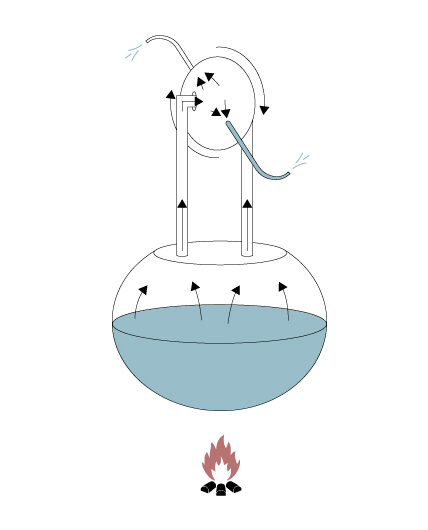
Equally remarkable is the aeolosphere (aeolipile) of Heron of Alexandria, widely considered the first steam-powered device in history.
By converting heated water into rotational motion, it demonstrated the fundamental principle behind the steam engine — nearly two millennia before the Industrial Revolution.
Try it yourself: set the interactive aeolosphere spinning in our 3D Lab.
Diagram of the aeolipile, the first steam-powered device in ancient Greek technology.
Plato’s Alarm Clock: the first alarm clock
Among the most ingenious applications of hydraulic control was the alarm clock of Plato — the first known alarm device in history, created around 350 BC to wake his students at the Academy for their dawn lectures.
Water flowed at a steady rate from one vessel into another. When the second vessel filled at the appointed moment, it emptied rapidly into a third, displacing the air inside and forcing it through a narrow pipe — producing a sound loud enough to wake a room.
It is a remarkably early example of programmed automation: a machine set in advance to act, without human intervention, at a precise moment in time.
Try it yourself: see the mechanism work in the interactive alarm clock of Plato.
The Automatic Theatre of Philo: programmable performance
Perhaps the most extraordinary creation was the automatic theatre of Philo — a programmable mechanical performance system.
Through a complex arrangement of ropes, weights, and timed mechanisms, it presented a full narrative with moving figures, sound effects, and scene transitions. It was, in essence, the “cinema” of the ancient world — an automated storytelling machine.
A cycle of discovery, loss and rediscovery
These inventions demonstrate that ancient Greek technology was not only advanced, but conceptually aligned with modern engineering thinking.
The evolution of technology is therefore not a simple linear progression, but a cycle of discovery, loss, and rediscovery.
Experience it yourself: the 3D Lab
Explore these mechanisms in three dimensions — take them apart, set them in motion and understand how they worked — in our 3D Lab. Or see the originals working in person at the Kotsanas Museum in Athens.